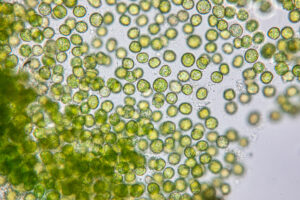
 Given proper circumstances (light, nutrients), all algae can bloom and a portion can become Harmful Algae Blooms (HABs) if the algae produces toxins. Most commonly cyanobacteria, dinoflagellates and diatoms will have this ability. Cyanobacteria are the most common reasons for HABs in freshwater, while dinoflagellates and diatoms are the most common reasons for HABs in salt water.
HAB’s accumulate through the food web and are potentially lethal for animals and humans, so there are many good reasons to monitor, study and understand the origin, evolution, duration and behavior of HAB’s.
Sequoia’s LISST-HAB system integrates three high-sensitivity fluorometers with the LISST-200X platform to enable simultaneous in-situ detection of Phycoerythrin, Phycocyanin, and Chlorophyll-a. This configuration supports pigment-specific discrimination of cyanobacteria and other phytoplankton groups, critical for HAB characterization.