In the underwater world, visibility is everything. Whether it’s a diver navigating murky waters, an autonomous vehicle scanning the seafloor, or a naval operation relying on optical sensors, understanding how light behaves underwater is critical. The beam attenuation coefficient (c) provides a simple measure of underwater visibility by quantifying light loss from absorption and scattering as it travels through water.
What Is Beam Attenuation?
Beam attenuation quantifies the reduction in light intensity as a collimated beam passes through water. It is only influenced by:
- Absorption by water molecules, dissolved substances (like colored dissolved organic matter, CDOM), and particles (e.g., pigments in plankton)
- Scattering by suspended particles such as sediment, plankton, or bubbles.
- Finally, note that density differences in the medium can steer the beam and affect attenuation. See Sequoia’s article on this topic!
The higher the beam attenuation, the lower and more blurred the visibility. This makes it a direct and reliable metric for assessing underwater optical conditions. It is measured with a transmissometer such as, for example, Sequoia’s LISST-Tau or LISST-200X.
Why It Matters for Defense
In naval and defense contexts, beam attenuation plays a crucial role in:
- Underwater navigation and piloting: Autonomous underwater vehicles (AUVs) and remotely operated vehicles (ROVs) rely on optical and acoustic sensors. High attenuation can limit the range and effectiveness of these systems.
- Mine and object detection: Optical systems such as laser line scanners and lidar are used to detect mines or submerged objects. Their performance is highly dependent on water clarity.
- Diver safety and mission planning: Real-time visibility data helps divers and mission planners assess risk and choose optimal deployment times and locations.
Applications in the Field
Modern defense operations use beam attenuation data in several ways:
- Real-time monitoring: Transmissometers mounted on buoys, ships, gliders or AUVs provide continuous updates on water clarity. For example this figure, showing a range of features elucidated with a LISST-Tau on a Teledyne Slocum Glider during a 4.5 day glider deployment:
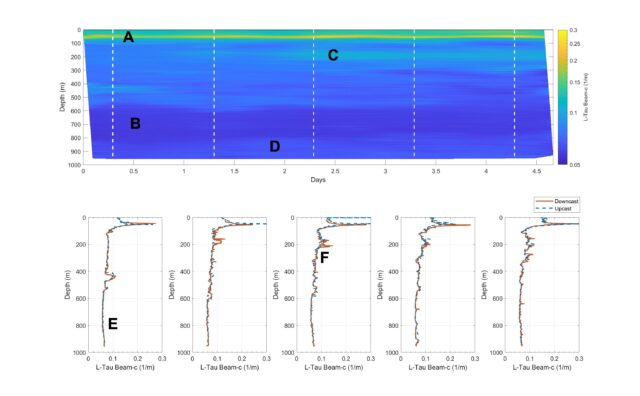
A) Subsurface particle maximum; B) Deep water particle minimum; C) Intermediate layers; D) Bottom Nepheloid Layer; E) Extreme stability between down- and up-cast; F) Resolution of fine-scale structure.
- Environmental modeling: Tactical Decision Aids (TDAs) integrate beam attenuation to simulate visibility conditions and optimise sensor deployment.
- Sensor fusion: Combining beam attenuation with acoustic and thermal data enhances situational awareness in complex environments like harbors, estuaries, and littoral zones. For example this report: Use of underwater gliders on marine surveillance and observations.
Summary
Beam attenuation is more than just a measure of water clarity—it’s a strategic asset in underwater defense. Quantifying light loss in the water column enables safer navigation, more effective surveillance, and smarter decision-making in complex aquatic environments.
Get in touch to discuss how beam attenuation from Sequoia instruments can advance your research!
Download this article as a pdf.
-

- LISST-Tau
-
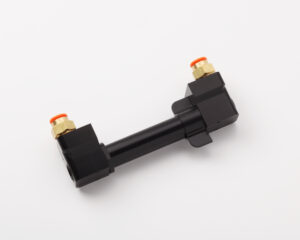
- LISST-Tau flow through chamber
-
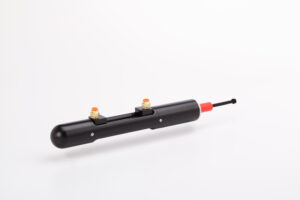
- LISST-Tau with flow through chamber installed
-
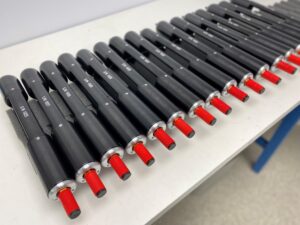
- LISST-Tau units ready to ship
-

- LISST-Tau frame