PyOPIA (Python Ocean Particle Image Analysis) was introduced in 2023. It is an open-source Python library for combing through large amounts of particle image data collected by camera instruments such as LISST-Holo / LISST-Holo2, SilCam, UVP-6 and others. Using a standardized and user-customizable pipeline, images are cleaned and segmented, before individual particles are geometrically measured and classified (CNN-based).
The resulting information is stored in standardized netCDF files for further use. Example applications of PyOPIA include the study of oil droplet and bubble formation under breaking waves in a laboratory flume, data analysis pipeline component in a Digital Twin of the Ocean and estimating copepod concentrations and sizes from ship-based casts.
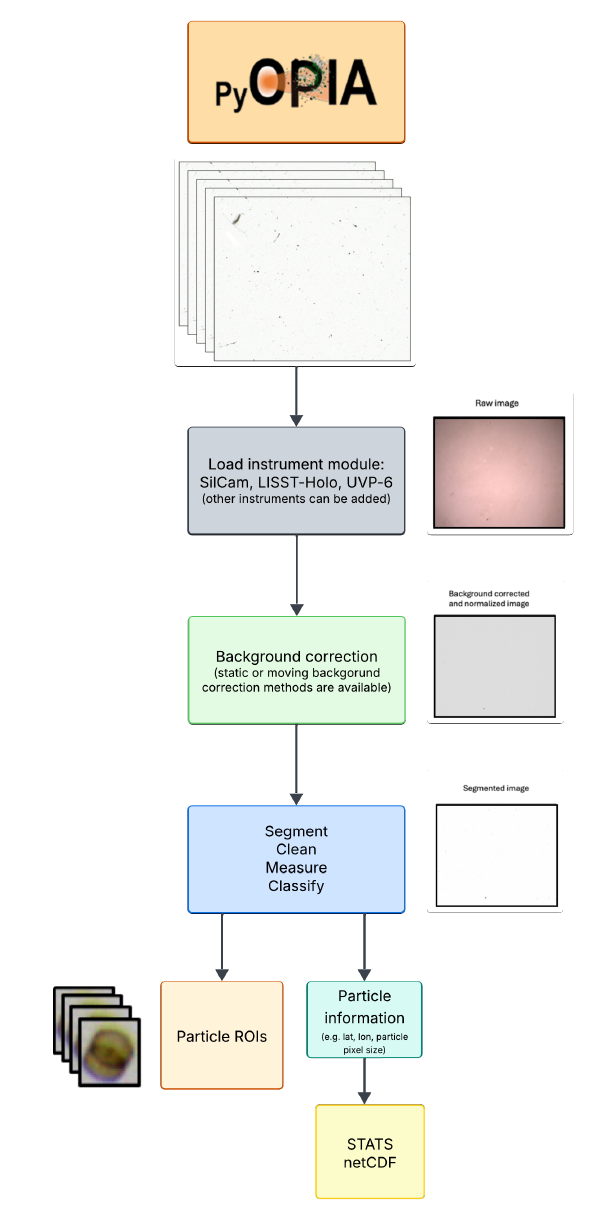
Since its introduction in 2023, Dr. Raymond Nepstad and co-workers at SINTEF Ocean in Norway have expanded on PyOPIA’s capabilities. At the 2026 Ocean Sciences Meeting in Glasgow, UK they presented a poster with a detailed update, summarized here:
- Data from multiple instruments can be run through the same analysis pipeline, facilitating direct comparison of particle statistics.
- A small convolutional neural network particle classifier, trained on 11 617 images belonging to 7 classes (bubble, copepod, diatom chain, faecal pellets, oil, oily gas, other) can classify your particles.
- Particle data from PyOPIA can be exported to EcoTaxa.
- Summary particle statistics and montages are easily made.
- Annotated netCDF file with metadata and config file (anybody can reproduce the analysis in the exact same manner).
Read the documentation, then Try PyOPIA today!
Download the poster by Nepstad, Mostaani, King, Nordam, Davies (2026): Making sense of underwater particle images with PyOPIA. Presented at Ocean Sciences Meeting 2026: 2026_OSM_PyOPIA_poster