The LISST-200X is Sequoia’s workhorse: a self-contained, submersible laser-diffraction particle size analyzer that measures suspended particle size and concentration (1–500 µm, in 36 size ranges), plus optical transmission, temperature, and depth, in oceans, rivers, lakes, and streams. Rated to 600 m and logging up to ~12 million size distributions internally, it is as much at home on a CTD rosette as it is on a mooring or a lab bench.
But the LISST-200X really shines when you accessorize it for YOUR application. Sequoia offers a wide range of accessories — from anti-fouling shutters and path-reduction modules to flow-through chambers, mounting frames and cables. Each designed for a specific deployment scenario. This guide walks through every accessory in the current (2026) lineup and explains WHEN to use it.
What Comes in the Box
Before considering any accessories at all, know what you already have, or will get with the purchase of a new LISST-200X (SEQ-FP-L200X). It ships with:
- Large External Battery Housing (incl. 16 alkaline D cells) for long deployments
- Small External Battery Housing plus charger and 4 rechargeable NiMH D cells.
- 0.5 m short battery cable (connects battery housing to LISST-200X)
- 2 m communications cable with built-in USB adapter
- Small Volume Background Test Chamber
- Pelican shipping case with custom foam, and Windows software
- The budget configuration (SEQ-FP-L200X-P) omits the two battery housings. This is a common choice for system integrators supplying their own power.
Deployment Hardware
BioBlock Anti-Fouling Shutter (SEQ-AC-L200X-BIO)

The BioBlock is a mechanical anti-fouling wiper and shutter that keeps the optical windows clean by mitigating biofouling. The wiper sweeps the windows before each measurement, and the shutter keeps them dark and protected between samples. With a BioBlock, the LISST-200X can be deployed for months on moorings or landers, where biofouling would otherwise foul the optics within days or weeks. Note that the Full Path Flow Through Chamber, the PRM and the BioBlock are mutually exclusive; none of these accessories can be used together.
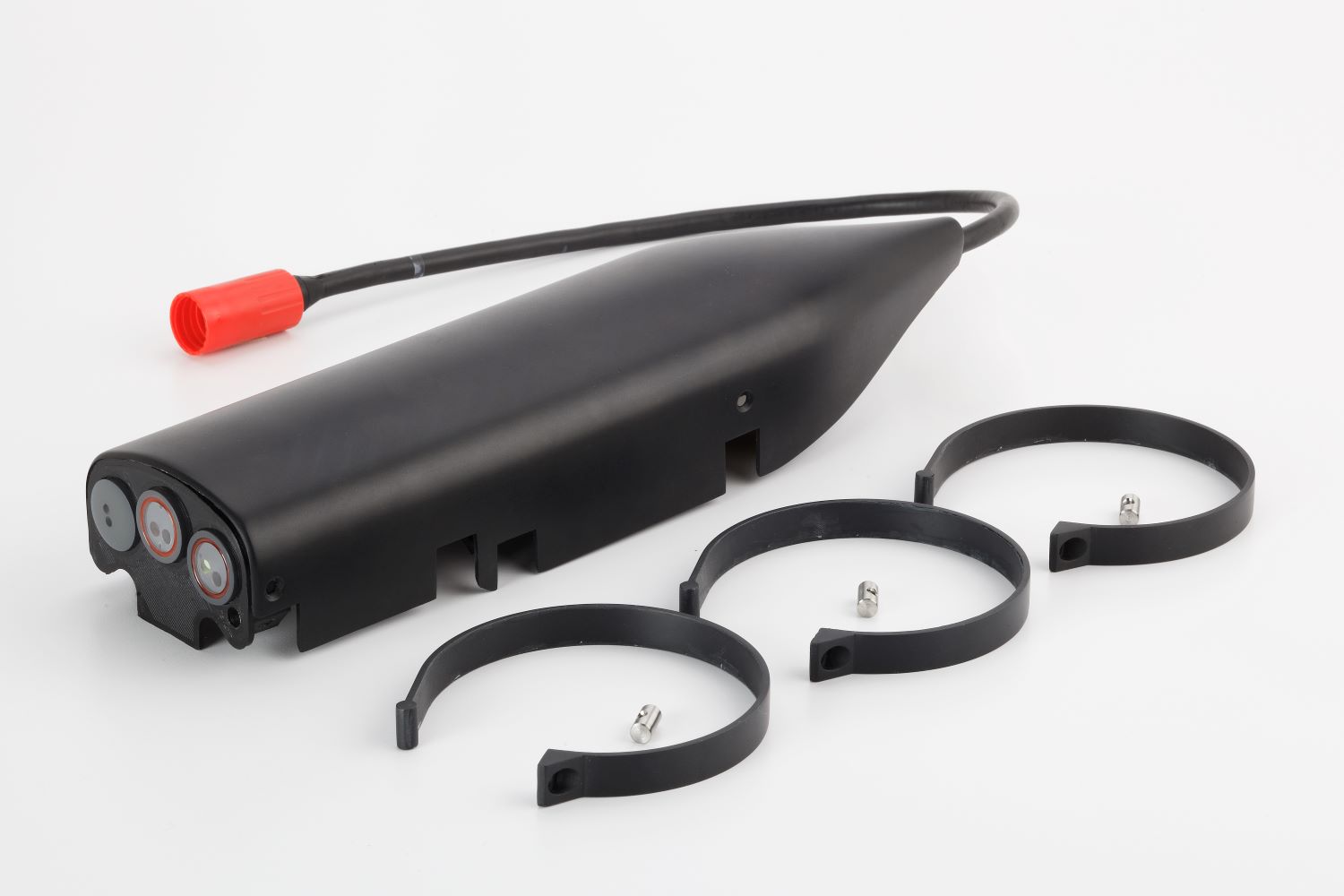
When to use it: Any unattended deployment longer than a few days; moorings, benthic landers etc. Note: the BioBlock’s depth rating is 200 m (versus 600 m for the LISST-200X), so it is not suitable for deep deployments. It is also not designed to run dry: on flood plains or in tidal salt marshes where the instrument may be exposed, configure depth-triggered sampling instead so the wiper only runs underwater. Mounting clamps (SEQ-AC-L200X-BIO-CLP) are included.
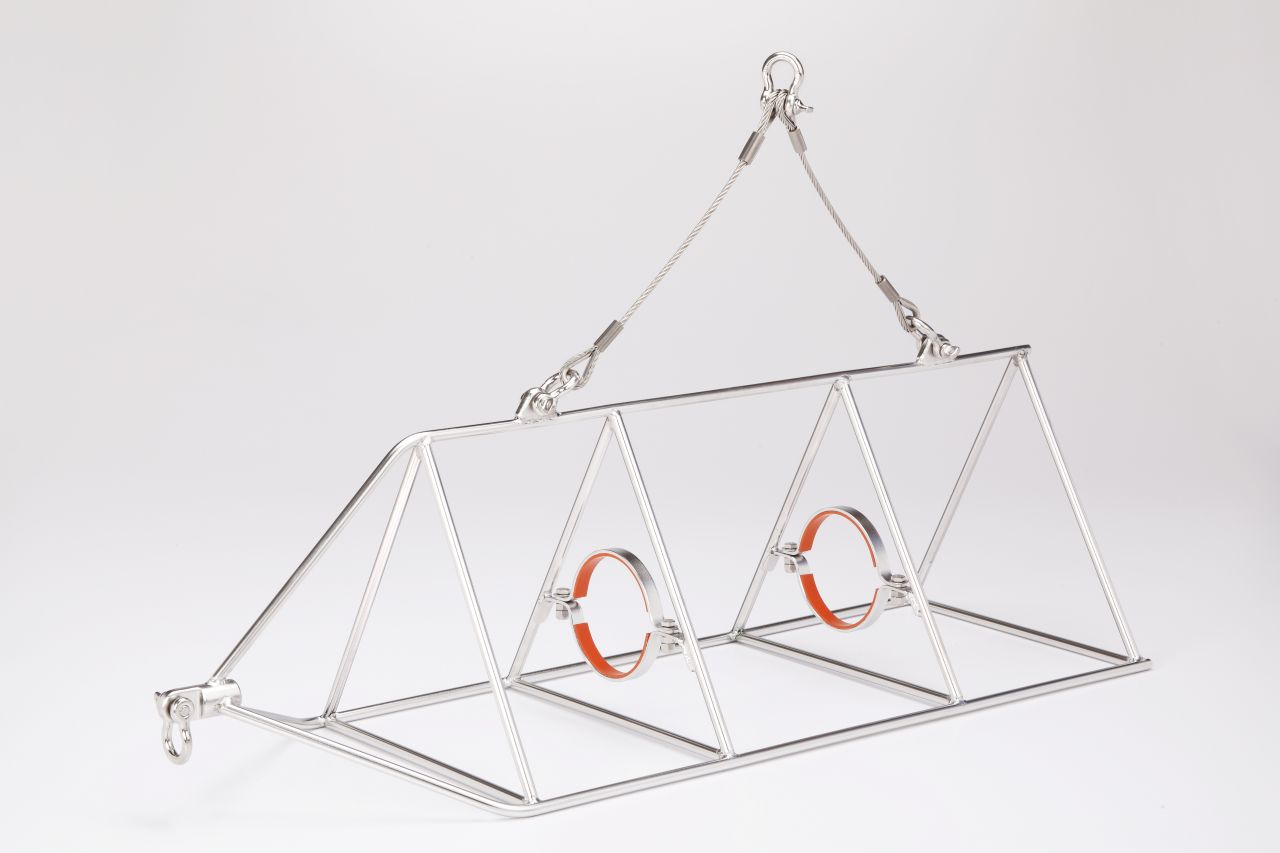
Mounting Frame (SEQ-AC-L200X-FRM) and Battery Clamps (SEQ-AC-L200X-FRM-CLP)
-

- LISST-200X in frame horisontal

A 316 stainless steel frame that holds the LISST-200X together with its Small Battery Housing as a single rigid package, complete with a bridle. This is the standard way to deploy the instrument vertically on a line, winch, or mooring without the battery housing dangling on its cable.
When to use it: Profiling or mooring deployments where you want instrument and battery to travel as one unit. If you break or lose the clamps, they are available separately as a set of two (SEQ-AC-L200X-FRM-CLP).
Scoop (SEQ-AC-L200X-SCOOP)

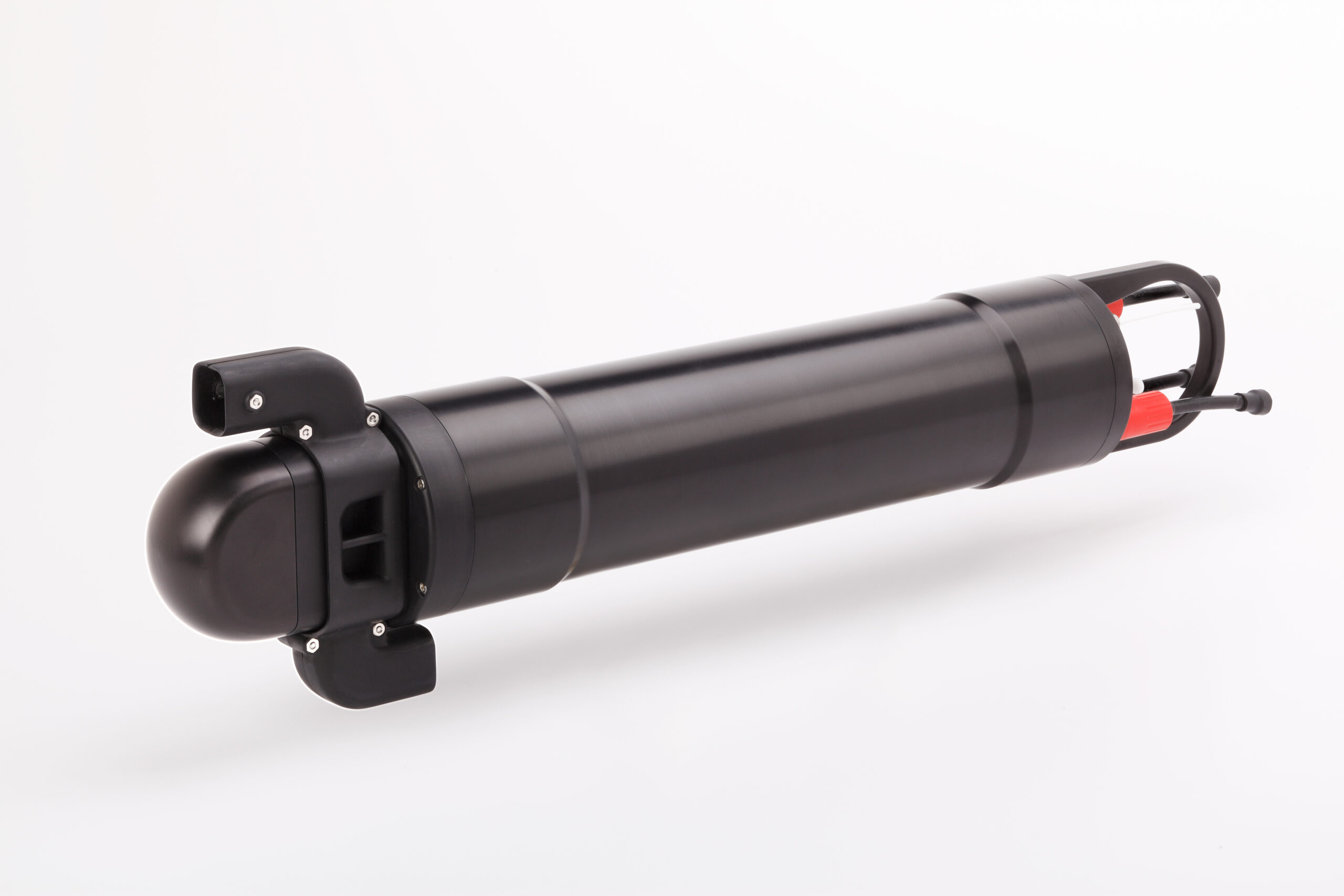
A delrin scoop that mounts on the LISST-200X optics end and diverts flow through the laser path.
When to use it: When using the LISST-200X in a river or tidal area it can be desirable to have it pointing into the flow. This poses an issue for the flow of water through the optical path. To mitigate this, Sequoia has developed the scoop that installs in the optical path of the LISST-200X. This ensuers that water is directed through the LISST-200X optical path. Read our article on the scoop!
Full Path Flow Through Chamber (SEQ-AC-L200X-CHFP)


A chamber that allows pumped water to pass directly through the LISST-200X optics. It installs simply and includes barb fittings for 1/2″ ID tubing, compatible with standard 1/2″ NPT fittings. Note that the Full Path Flow Through Chamber, the PRM and the BioBlock are mutually exclusive; none of these accessories can be used together.
When to use it: Laboratory and flow-through applications. Using a peristaltic pump and a stir plate you can maintain a suspension in a beaker, athen pump it throuhg the LISST-200X for continuous measurements of the particle size distribution. Note: If your primary use is the lab, also consider Sequoia’s LISST-Portable|XR, which is purpose-built for laboratory particle sizing.
Path Reduction Module – PRM (SEQ-AC-L200X-PRM)


A glass cylinder (fused-quartz) with mounting hardware that reduces the optical path from the standard 25 mm to 5 mm; an 80% reduction. Shortening the path 80% extends the measurable concentration range by a factor of five; from roughly 665 mg/l up to about 3,300 mg/l for particles with a D50 of 16 um (medium silt). Note that the Full Path Flow Through Chamber, the PRM and the BioBlock are mutually exclusive; none of these accessories can be used together. Read our PRM article!
When to use it: High-concentration environments: dredging plumes, muddy rivers and estuaries, harbor waters, and sediment transport studies where transmission would otherwise fall below the working range. Important: the standard small-volume Background Test Chamber does not work with the PRM installed. You should use the Large Volume Test Chamber (below) to collect your clean-water background with the PRM installed.
Large Volume Test Chamber (SEQ-AC-L200X-CHLG)
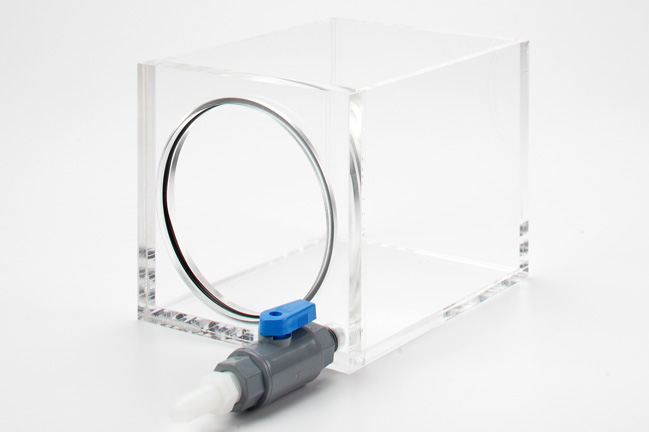
Large Volume Test Chamber for LISST-200X
A clear acrylic chamber with O-ring seal and drain that holds a larger volume of clean water around the optics while you record the instrument background. You must use this chamber (or a similar setup) to collect a clean water background if you have a PRM installed.
When to use it: Essential when the Path Reduction Module is installed.
Custom-Length Cables (SEQ-AC-L200X-CBLB + SEQ-AC-LISST-CBLY)

For non-standard setups, Sequoia can build cables to order: order one SEQ-AC-L200X-CBLB base item (USB for topside data and power, underwater connector on the subside) plus x m of SEQ-AC-LISST-CBLY, where x is your desired cable length (2 – 50 m is possible). Note: A female pigtail to unterminated tinned wires (SEQ-AC-LISST-PT5F) is available for integrators wiring to their own electronics.
When to use it: Docks, piers, test tanks, and fixed installations where the instrument sits farther than 2 m from the computer. (LISST-Black and LISST-HAB variants use their own cable base, SEQ-AC-HAB-CBLB, with a 15 V power brick.)
CTD Cables (SEQ-AC-L200X-SCBL-MM or SEQ-AC-L200X-SCBL-AM)
2 m cables connecting the LISST-200X to Sea-Bird SBE-9 CTDs, wired pin-to-pin. The -MM version has Impulse MCIL-6-FS connectors on both ends (for CTDs with MCBH connectors); the -AM version has an AG206-FS connector for CTDs with AG connectors. READ THIS ARTICLE! to find out what cable you need.
When to use it: Adding the 200X to a CTD rosette. The 200X is pin-compatible with Sea-Bird CTDs — it draws power from the CTD and outputs mean particle size and total volume concentration as analog voltages, viewable in real time through the CTD’s own telemetry, while the full size distributions are stored internally.
Accessories INCLUDED with the LISST-200X
Background Test Chamber (SEQ-AC-L200X-CHZS)

The standard small-volume chamber holds a small amount of particle-free water while a clean-water background is obtained. Every LISST-200X needs a good background before deployment; this is the accessory for routine use with the standard 25 mm path.
Large External Battery Housing (SEQ-AC-L200X-LEB)

Anodized aluminum housing with 16 installed non-rechargeable alkaline D cells and underwater connectors, rated to 600 m. Sized for long deployments.
When to use it: Extended autonomous deployments — moorings, landers, or long sampling programs — where you cannot service or recharge batteries. Order connecting cable SEQ-AC-L200X-BCS if you need a spare.
Small External Battery Housing (SEQ-AC-L200X-SEB)
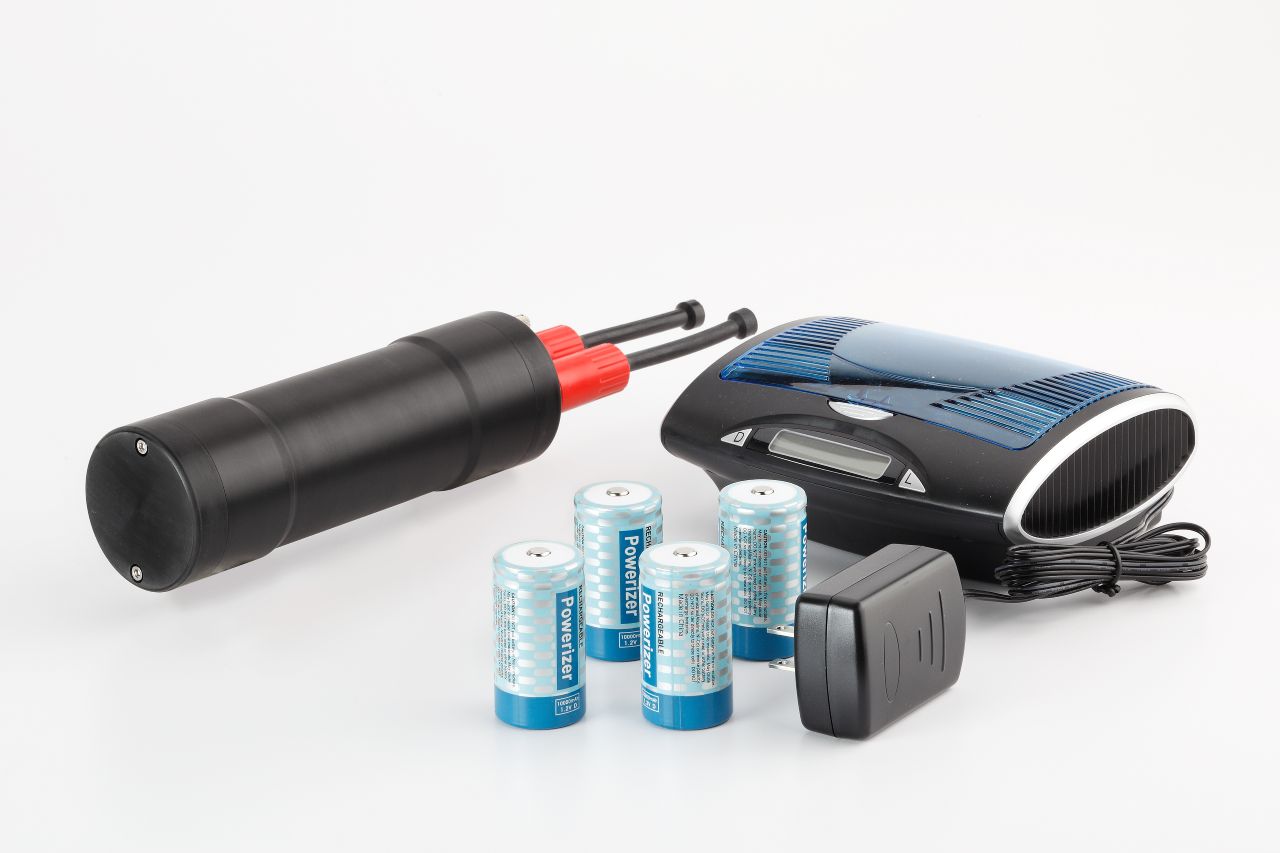
LISST-200X small external battery housing w/ charger
Compact plastic housing with 2 rechargeable NiMH D cells, rated to 600 m, supplied with 4 cells and a charger. It powers the 200X for ~ 6-8 hours of continuous 1 Hz sampling. Enough for a full day of typical profiling or burst sampling. The small external Battery Housing fits with the LISST-200X in the frame.
When to use it: Day trips, profiling, towed surveys, and any deployment where weight matters (the small housing is only 30 cm long). With four supplied batteries you can always have two on the charger and two in use. Replacement NiMH D cells (SEQ-AC-L200X-SBAT), a spare charger (SEQ-AC-L200X-SCHGR), and a 2 m battery cable (SEQ-AC-L200X-BC2) are available.
Integrated Communication and Power Cable, 2 m (SEQ-AC-L200X-CBL02)

LISST-200X 2m power and comm cable
A 2 m cable with built-in USB adapter that handles both data and external power, letting the instrument run off a PC’s USB port for setup, real-time display (for example in the lab), and data offload.
Sensor Upgrades (LISST-200X -> LISST-Black / LISST-HAB / pH)
The LISST-200X can power and log up to three external analog sensors, turning it into a multi-parameter platform:
Electronics upgrade (SEQ-AC-L200X-UPG): retrofits an existing 200X to support external sensors (sensors and mounting hardware sold separately).
LISST-Black Sensor Package (SEQ-AC-BLACK-PKG): Oil spill-oriented sensor package with mounting hardware, cables, and Turner Designs crue oil and refined oil fluorometers.
LISST-HAB Sensor Package (SEQ-AC-HAB-PKG): complete harmful-algae (HAB) package with Turner Designs chlorophyll/phycocyanin/phycoerythrin fluorometers — the tool for monitoring cyanobacteria and harmful algal blooms alongside particle data.
LISST-HAB/-Black sensors and mounting hardware
Mounting and cable hardware only (SEQ-AC-HAB-SNR-MNT): for LISST-200X users who already own the correct Turner Designs sensors.

LISST-Black/-HAB mounting hardware only
LISST-pH sensor package (SEQ-AC-L200X-PH): ANB OC300 pH sensor (2–10 pH, 300 m rated) with analog converter module for 200X integration, plus mounting clamps (SEQ-AC-L200X-PH-CLP).
When to use it: Moored or profiled monitoring where you want coincident, synchronized measurements. For example pairing size distributions with chlorophyll-a fluorescence to distinguish algal from mineral particles, or with pH in aquaculture and acidification studies or for oil spil research.
Quick Reference: Which Accessories for Which Job?
| Application | Recommended Accessories |
|---|---|
| CTD rosette profiling | SBE-9 CTD cable (-MM or -AM) |
| Shallow profiling | Mounting Frame, Small Battery Housing |
| Mooring / lander (weeks or months) | BioBlock, Large Battery Housing, 2 m battery cable, Mounting Frame |
| Turbid water | Path Reduction Module, Large Volume Test Chamber |
| River/stream | Scoop, Mounting Frame |
| Laboratory / pumped flow | Full Path Flow Through Chamber |
| Fixed install 2-50 m | Custom-length cable |
| HAB / Oil spill / pH monitoring | Sensor upgrade package (HAB, Black, or pH) + possibly electronics upgrade |
The Bottom Line
No single 200X configuration fits every application. If you are unsure which accessory you may need, Sequoia’s team can help you.
For further reading, see the LISST-200X product page and associated FAQ.